

VB-Audio - C-Limiter
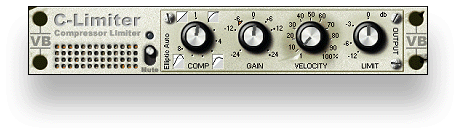
VB-Audio - C-Limiter
C-Limiter (and D-Limiter before it) is the first digital audio processing unit that introduces a new class of algorithm specifically designed to limit audio signals without going through any compression process.
Description
In C-Limiter, there is no threshold. The Limiter gets into action only if the signal goes over 0db. This allows to save maximum integrity of the sound because absolutely no processing is done as long as the sound remains below 0db.
When the Limiter gets a slap (the signal goes over 0db) then it becomes active and plays the ball back. It is here like a real tennis game with the signal. The Limiter sends back the energy given by the signal, making sure that the signal never crosses the 0-dB border (the output gain, named 'limit', sets this limit).
For the sidelights on history, if the C-Limiter concept seems to be simple, the algorithm of this effect remains inimitable because it's based on a fortuitous programming mistake, difficult to reproduce by a strict reasoning...
| Concept C-Limiter is a simple and fast compressor/limiter used to optimize the power of the sound while it strictly respects the maximum audio level set by the limit. |
 |
 Insert it ! that's all ! Insert it ! that's all !By default, C-Limiter is ready to be used as a limiter (compression is disabled). You just have to adjust the limit by moving the output level knob. |
 Managing reaction rate (Release Time). Managing reaction rate (Release Time).The "Velocity" button indirectly controls the reaction rate of the limiter, and therefore the distortion rate, too (100% = max distortion, 1% = Min distortion). (The attack time of the limiter is null). Understanding the "velocity" knob is easy. Let's think about a sound engineer who's decreasing the gain slider on the mixing console when the sound gets suddenly louder, and then re-sets the original level after getting a more regular level again... slowly or quickly... it depends on the speed of the guy, on his velocity... |
 Auto Compression Auto CompressionThe first knob allows to compress the sound without gain reduction, following an elliptic transfer graph. Here, the compression rate sets a curve shape. This allows to add energy or to generate harmonics if the input signal goes above 0db. |
 Integrity of the compression Integrity of the compressionBetween 1 and 2 the sound level remains below 0db, but it seems louder. The picture on the right shows you the compression curve for a ratio of 2. |
 Compression above 0db Compression above 0dbPast 2, the compression rate still produces louder and louder sound but more and more aggressive. The level can go over 0db and therefore eventually generate more or less usable harmonics. The picture on the left displays the compression curve for a rate of 4. |
 The Gain Knob. The Gain Knob.This is a simple input gain which can be considered as a level reducer or a gain before threshold. This is very useful to tweak the level before the limiter processes it. |
 Tip : Maximize the Sound with C-Limiter. Tip : Maximize the Sound with C-Limiter.We use a first unit just to limit the level of the sound (-6 db for example) and a second one to compress and maximize it in a comfortable way. (comp : 2 , Gain +3db). |
Tech Specs
| Plug-in Name : Processing Type : Possible Routing : Usual Routing : |
C-Limiter. Real-Time Limiter. Insert (Strip ou BUS) Master end of chain. |
Hardware Requirement
 PC Set-up (min) : PC Set-up (min) : Memory Set-up (min) : Screen Set-up (min) : Options / remarks : PC Set-up (recommanded) : Memory Set-up (recommanded) : Screen Set-up (recommanded) : |
Intel Pentium© 200MHz. RAM 64Mb. 800x600 (16bits colors min). - Intel Pentium©III 500MHz. RAM 128Mb. 1024x768 (16bits colors min). |
Inputs / Outputs
 Inputs : Inputs : Data Type : Supported SampleRate : Outputs : Data Type : Supported SampleRate : |
Mono or Stereo float IEEE32 all above 11000 Hz. Same as Inputs Same as Inputs Same as Inputs |
Parameter's Limit
 Compression : Compression :Gain : Velocity : Limit : |
1 to 8. -24db to +24db. 1 to 100%. -12db to 0db. |
Automated Parameters (VST version)
| Parameters | Unit | V Default | V Min | V Max |
| Gain | db | - | -24.0 | +24.0 |
| velo | % | - | 1.0 | 100.0 |
| Limit | - | - | 0.25 | 1.0 |
| comp | ratio | - | 1.0 | 8.0 |
| Mute | on/off | - | 0.0 (off) | 1.0 (on) |


